When Reading Becomes More Than Reading: A Reading Club for Curious Kids
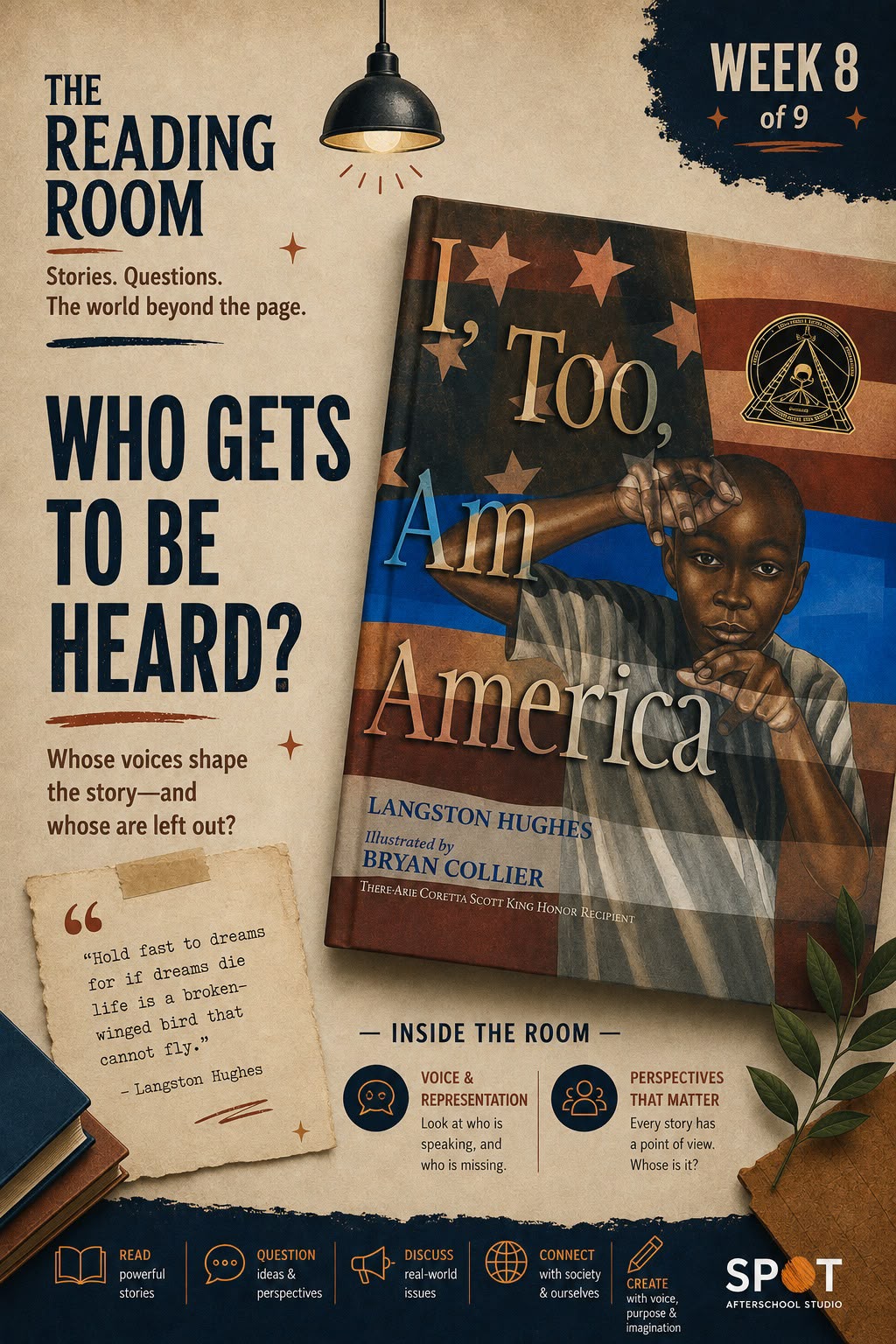
Discover SPOT’s Reading Club for teens aged 10+ in Bengaluru. Explore powerful stories and poetry through theatre, debates, podcasts, current affairs and a final student showcase.
What happens when a child reads a story and doesn’t just ask, “What happened?”
What if they start asking:
“Was that fair?” “Why did the character make that choice?” “Would the same thing happen today?” “What would I have done?”
That is where reading can become something much bigger.
For young readers, literature can be a doorway into conversations about identity, justice, freedom, equality, morality, culture and the world around them.
A story can become a debate.
A poem can become a conversation about identity.
A character’s choices can lead to questions about right and wrong.
And a fictional situation can help young people think about very real issues.

More Than a Traditional Reading Club
Reading doesn't have to stop at understanding a story or answering comprehension questions.
At SPOT Reading Room, students explore selected stories and poems and then step inside the ideas behind them.
They question characters. They examine choices. They discuss different perspectives. They connect literature with current affairs and real-world situations. And they create, perform and communicate their own ideas.
The programme combines literature, critical thinking, discussion, theatre, debate and creative expression to make reading an active experience.
Because sometimes the most interesting part of a story begins after the last page.
What Will Students Read?
The programme brings together a selection of powerful short stories and poems. Each literary work opens the door to a different question about people, society and the world around us.
Thank You, Ma'am — Langston Hughes
Crime, compassion & second chances
What happens when someone who has made a mistake is met with compassion instead of punishment?
Students explore crime, consequences, empathy and second chances through a mock courtroom and theatre activity.
Still I Rise — Maya Angelou
Identity, stereotypes & finding your voice
Through Angelou's powerful poem, students explore identity, stereotypes, resilience and self-expression.
They then take those ideas into Identity Poetry and an Ethics Podcast, giving them a chance to think about how people find and express their own voices.
Harrison Bergeron — Kurt Vonnegut
Equality vs. equity
If everyone is treated exactly the same, does that automatically make something fair?
This story becomes a starting point for exploring equality, equity and the structures of society through a Create-a-Government activity and theatre.
Where the Mind Is Without Fear — Rabindranath Tagore
Freedom, citizenship & India
Tagore's poem opens up questions about freedom, education, citizenship and the kind of society people aspire to build.
Students connect the text with media literacy and current affairs, moving between literature and the world around them.
The Ones Who Walk Away from Omelas — Ursula K. Le Guin
Privilege, morality & the greater good
Can the happiness of many ever justify the suffering of one?
Students grapple with this difficult moral question through a town-hall debate and theatre activity, exploring privilege, responsibility and competing perspectives.
Caged Bird — Maya Angelou
Freedom, oppression & protest
Students explore the contrasting ideas of freedom and restriction and examine how people respond to oppression.
The discussion moves into a protest campaign and real-world case exploration.
The Paper Menagerie — Ken Liu
Identity, culture, immigration & belonging
What shapes our sense of belonging? How do culture, family, language and heritage influence identity?
Students explore these questions through a Museum of Me activity and character theatre.
Equality — Langston Hughes
Discrimination, fairness & representation
Students examine ideas around equality, discrimination and representation and then take on the roles of journalists in a newsroom simulation, connecting the literary themes with current affairs.
When Literature Meets the Real World
The stories aren't treated as isolated pieces of literature.
Throughout the programme, students make age-appropriate connections between what they read and what happens around them.
They may explore questions around:
- The Indian Constitution and children's rights
- Education as a fundamental right
- Freedom of speech and protest
- Equality and discrimination
- Media and different perspectives
- Youth activism
- Crime and restorative justice
- Current affairs and civic issues
The purpose isn't to give students a predetermined answer.
Instead, they are encouraged to ask questions, look at evidence, distinguish fact from opinion, recognise bias and understand multiple perspectives.
The goal is to help them develop their own thoughtful responses.
From Reading to Doing
One of the biggest differences between this Reading Room and a conventional reading programme is what happens after the reading.
Students don't simply finish a story and move on to the next one.
They might:
Step into a mock courtroom and examine a situation from different perspectives.
Use theatre and role-play to understand characters and choices.
Create a podcast around an ethical question.
Take part in debates and town halls where they have to listen, respond and build an argument.
Participate in a newsroom simulation and think about how stories and perspectives are presented.
Write poetry and creative pieces inspired by the themes they explore.
Connect literature with current affairs and real-world cases.
The result is a reading experience that is active, collaborative and connected to the world outside the classroom.
What Skills Does the Reading Room Build?
While literature is at the centre of the programme, students are developing much more than reading skills.
Reading & Literary Skills
Students practise:
- Reading comprehension
- Literary analysis
- Understanding symbolism and metaphor
- Character analysis
- Connecting fiction to real-world issues
- Interpreting different meanings and perspectives
Critical Thinking
They learn to:
- Ask thoughtful questions
- Separate fact from opinion
- Evaluate evidence
- Identify bias
- Consider multiple perspectives
- Build and communicate arguments
Communication & Creative Skills
The programme creates opportunities for:
- Public speaking
- Debate and discussion
- Theatre and role-play
- Creative writing
- Spoken word
- Podcasting
- Collaborative storytelling
Social & Civic Awareness
Students explore:
- Justice
- Equality and equity
- Identity and belonging
- Rights and responsibilities
- Current affairs
- Empathy and perspective-taking
These skills can extend well beyond a Saturday programme. They can help students become more thoughtful readers, confident communicators and curious participants in the world around them.
Is This Reading Room Right for Your Child?
This programme isn't only for students who are “good at English.”
It may be a great fit for a child who:
Always has a book in their hand and loves talking about what they're reading.
Has a strong opinion about everything and enjoys explaining why.
Loves speaking, debating, presenting or performing.
Wants to understand the world around them and is curious about society and current affairs.
Keeps asking, “But is that actually fair?”
Enjoys English, literature, writing or poetry.
Loves theatre, storytelling or role-play.
Follows the news or asks questions about how society works.
Enjoys challenging ideas and hearing perspectives that may be different from their own.
Is curious about why things are the way they are and isn't satisfied with simple answers.
They don't need to have all the answers.
They don't even need to agree with everyone.
They simply need to be willing to:
Read. Question. Discuss. Disagree respectfully. Think deeper. Speak up.
And Then Comes the Showcase
The programme includes 8 learning sessions followed by a special 9th Saturday Student Showcase.
This final session gives students an opportunity to bring together what they've explored throughout the programme and turn their learning into something they can share.
The showcase is built around the theme:
“What Does Justice Mean to Us?”
Students may present performances, podcasts, debates, exhibitions and other creative work developed through their sessions.
This means the programme isn't simply about completing eight classes.
There is a journey:
Read → Question → Discuss → Create → Share
Students get to see how an idea that began in a story, poem or discussion can evolve into something of their own.
And the final showcase gives them a chance to communicate what they think, what they have explored and what they have created.
A Reading Room for Curious Minds
The best reading experiences don't always end when the book closes.
Sometimes, that's when the interesting questions begin.
At SPOT Reading Room — Justice, Identity & Society, children get a space to explore those questions through literature, discussion, creativity, theatre and real-world connections.
It's a space for the child who reads a story and wants to talk about it.
For the one who challenges an idea.
For the one who asks “Why?”
For the one who says “I don't agree — and here's why.”
And for the one who is still figuring out what they think.
8 learning sessions. 1 student showcase. A whole lot of questions.
Read. Question. Discuss. Think deeper. Speak up.
Age: 10+ SPOT, Whitefield, Bengaluru
SPOT is a microschool in Whitefield, Bangalore for teens aged 10–17.
Admissions are open for 2026–27.
Enquire about a place →