Gifted and 2e in India: The Resource Guide Nobody Gave You (2026)
A practical guide for Indian parents of gifted and twice-exceptional children — what 2e means, how assessment works in India, schooling options, exam accommodations, and where to find community.
Gifted and 2e in India: The Resource Guide Nobody Gave You
Short answer: India has no national gifted education framework, no standard 2e identification pathway, and very few schools designed for these learners. What it does have is a growing network of private psychologists, a flexible open schooling board (NIOS), exam accommodation provisions under the RPwD Act 2016, and a handful of small schools and microschools doing the work. This guide maps what exists and what to do in what order.
First: what is twice-exceptional?
A twice-exceptional (2e) child is gifted and has one or more disabilities or learning differences — commonly ADHD, autism, dyslexia, dyscalculia, dysgraphia, anxiety, or slow processing speed.
The defining problem of 2e is not either exception. It is that they mask each other.
- The giftedness compensates for the disability, so the disability is never identified
- The disability suppresses the giftedness, so the giftedness is never identified
- Or both cancel out and the child looks resolutely, frustratingly average — and no one investigates anything
This is why 2e children are typically identified late, often after a collapse. The most common presentation we see in India is a child who did brilliantly until Grade 5 or 6, then began sliding as executive function demands rose, and has since been described in every report card as "capable but not applying himself."
The term is used to describe intellectually gifted students who also have co-occurring challenges, learning differences, or disabilities.
The Indian problem, stated plainly
Three structural gaps:
1. Giftedness is not a recognised category in Indian school policy. The RPwD Act 2016 covers disability. Nothing covers giftedness. So a 2e child can access disability provisions but nothing addresses the other half of the profile — which means the support offered is remedial rather than talent-developing. A child gets extra time in maths and nothing at all for the fact that they read at university level.
2. Assessment is private, expensive and inconsistent. There is no public pathway. Quality varies enormously between practitioners.
3. "Gifted" in India usually means "olympiad-ready." Which is not the same thing at all, and has produced an entire coaching industry that is actively harmful to 2e children.
Step 1: Assessment — what to actually ask for
You need two things, and most parents only get one.
A cognitive assessment
Typically the WISC-V (Wechsler Intelligence Scale for Children, 5th edition), administered by a licensed clinical psychologist. For 2e children, the profile matters far more than the headline number — look for large gaps between index scores (e.g. very high Verbal Comprehension alongside low Processing Speed or Working Memory). That gap is often where the 2e story lives.
An academic achievement and processing assessment
To identify specific learning disabilities. In India this usually includes tools such as the NIMHANS Index of Specific Learning Disabilities (or NIMHANS SLD Battery), plus curriculum-based assessment.
What to ask the psychologist before you book:
- Have you assessed twice-exceptional children before?
- Will you report index-level scores, not just Full Scale IQ?
- Will the report include recommendations for enrichment, not only remediation?
- Will it be written in language a school can act on?
That last one matters more than parents expect. A report that says "the child presents with executive dysfunction" is useless to a class teacher. A report that says "give instructions one step at a time, in writing, and allow him to type responses" changes a school year.
Where assessments happen in India: NIMHANS (Bengaluru) and other government institutes for public-sector assessment with long waits; university psychology departments; and private clinical psychologists in most metros. Costs vary widely — ask for the full package price including report and feedback session before booking.
Step 2: Understanding the school problem
Once you have the report, you face the real question. Most Indian schools can do one of these but not both:
| What a gifted child needs | What a disabled child needs |
|---|---|
| Acceleration, depth, complexity | Scaffolding, time, structure |
| Intellectual peers | Emotional safety |
| Freedom to go sideways | Predictable routine |
| To be stretched | To be protected |
A 2e child needs all eight columns simultaneously, which is why the standard responses — "put him in the top set" or "put him in remedial" — both fail.
The specific failure mode to watch for: a school that reads the disability, drops expectations, and quietly parks your child in undemanding work. The child is now comfortable and bored, and boredom in a gifted child looks identical to behavioural difficulty.
Step 3: Schooling options in India
Mainstream school with an IEP and accommodations. Possible in some private schools. Requires an engaged coordinator and a school willing to enrich as well as support. Ask to see a real IEP template before you believe it exists.
Alternative and progressive schools. Less rigidity, more room to move. But few have special educators on staff. In Bangalore, Poorna Learning Centre is a long-standing example of an alternative school with special education capacity.
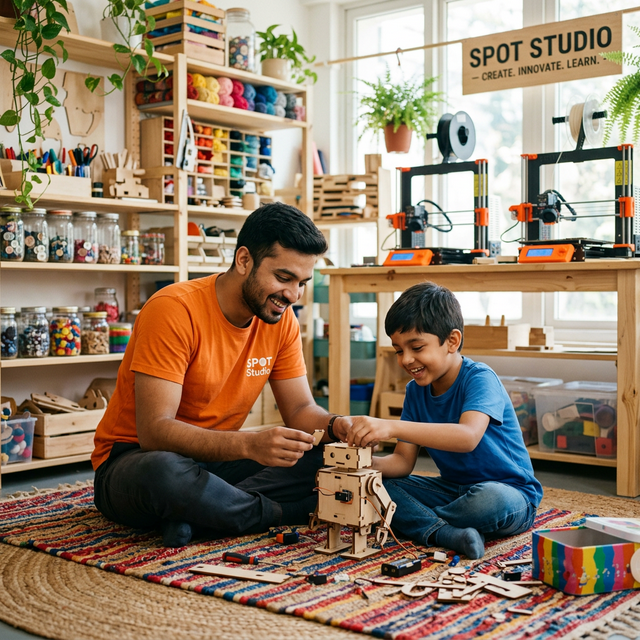
Microschools. Small cohorts (10–30), individual learning plans, mixed-age grouping. Structurally the best fit for 2e because personalisation is cheap when the group is small. SPOT Microschool in Bengaluru is designed specifically for this population — learners aged 10–17, IGCSE and NIOS pathways, around 20 learners, with strengths-first individual plans.
Online schools. 21K School offers NIOS and British curricula fully online for ages 3–18. Removes sensory and social load; adds isolation. Often works well as a bridge year.
NIOS / homeschooling. NIOS allows enrolment from Class 3 (Open Basic Education) through Secondary and Senior Secondary, with subject choice, multiple exam attempts (credit accumulation across up to nine chances over five years), and on-demand examinations for some subjects. This is the single most useful structural tool available to Indian 2e families and remains badly under-known.
Cambridge / Edexcel as a private candidate. IGCSE can be taken through registered exam centres such as the British Council. Allows subject flexibility and a strong international pathway without a school.
Step 4: Exam accommodations
Under the Rights of Persons with Disabilities Act, 2016, students with benchmark disabilities are entitled to provisions in board examinations. Depending on board and documented need, these can include:
- Compensatory time (commonly 20 minutes per hour)
- A scribe or reader
- Use of a computer or calculator
- Exemption from a language or substitution of subjects
- Separate seating
What you need: a disability certificate issued by a competent medical authority, plus a psycho-educational report. Start early — 12 to 18 months before the board exam year, not in the term before. The certificate process alone can take months.
CBSE, CISCE, NIOS and state boards each have their own circulars and their own forms. Get the current circular directly from the board's site rather than relying on a school's summary.
Step 5: Community and information
Isolation is the underrated harm here. Parents of 2e children in India are often the only person in their extended family who believes the child is both brilliant and struggling.
Where to look:
- Parent groups — WhatsApp and Facebook groups for homeschooling, alternative schooling and neurodivergent parenting exist in every major Indian city and are the fastest route to honest school reviews
- Indian organisations — the Association for Learning Disabilities India (ADHD and LD focused), Action for Autism (Delhi), and Sethu (Goa) all publish parent-facing material
- Global 2e resources that translate well — SENG (Supporting Emotional Needs of the Gifted), Hoagies' Gifted Education Page, and Bridges 2e Media, which runs 2eNews.com covering news and trends in 2e, and Variations2e magazine
- Books — Twice Exceptional (Scott Barry Kaufman, ed.), Bright Not Broken (Kennedy, Banks & Grandin), Differently Wired (Deborah Reber), Smart but Scattered (Dawson & Guare) for executive function
What to do this month
If you are early in this and overwhelmed, here is the order:
- Write down the pattern, not the incidents. Three sentences: what your child can do that surprises adults, what consistently defeats them, and when the gap first appeared.
- Book a cognitive assessment with someone who has seen 2e before. Ask the four questions above.
- Stop the tuition if the tuition is remedial drilling. It is usually making things worse.
- Find one other parent with a similar child.
- Then look at schools.
Most families do this in reverse — school hunt first, assessment last, community never. It costs them two years.
Frequently asked questions
Is giftedness recognised in Indian education policy? Not as a formal category with entitlements. NEP 2020 references identifying and supporting gifted students, but there is no national identification framework or mandated provision comparable to disability rights under the RPwD Act 2016.
How do I get my child assessed for giftedness in India? Through a licensed clinical psychologist, usually with the WISC-V. Public options such as NIMHANS exist with long waiting periods; private assessment is faster and more expensive. Ask specifically whether the practitioner has assessed twice-exceptional profiles.
Can a child be gifted and have ADHD or autism? Yes — that combination is precisely what twice-exceptional means. It is common and commonly missed, because the two profiles mask each other.
What is the best board for a 2e child in India? NIOS is the most flexible: subject choice, multiple exam attempts, on-demand exams for some subjects, and no attendance requirement. IGCSE is strong for depth and subject flexibility with an international pathway. CBSE and state boards are workable with formal accommodations but offer the least structural flexibility.
Are there schools for gifted children in India? Very few designed specifically for giftedness. There are alternative and progressive schools with more flexibility, and a small number of microschools built for neurodivergent and 2e learners — SPOT Microschool in Bengaluru is one. Most Indian 2e families end up building a combination: a small school or homeschool base plus outside mentors for the child's area of intensity.
My child is bright but failing. Where do I start? With an assessment, not a tutor. The most common expensive mistake is two years of coaching for a problem that was never an academic-content problem.
SPOT Microschool is a neurodiversity-affirming microschool in Bengaluru for learners aged 10–17, offering IGCSE and NIOS pathways, built for gifted, neurodivergent and twice-exceptional learners. Book a conversation.
SPOT is a microschool in Whitefield, Bangalore for teens aged 10–17.
Admissions are open for 2026–27.
Enquire about a place →